
The Monk Olive Oil • Corfu • Limited Release
Your Bottle
A personal guide to tasting, serving and preserving your individually
numbered bottle of The Monk Olive Oil.
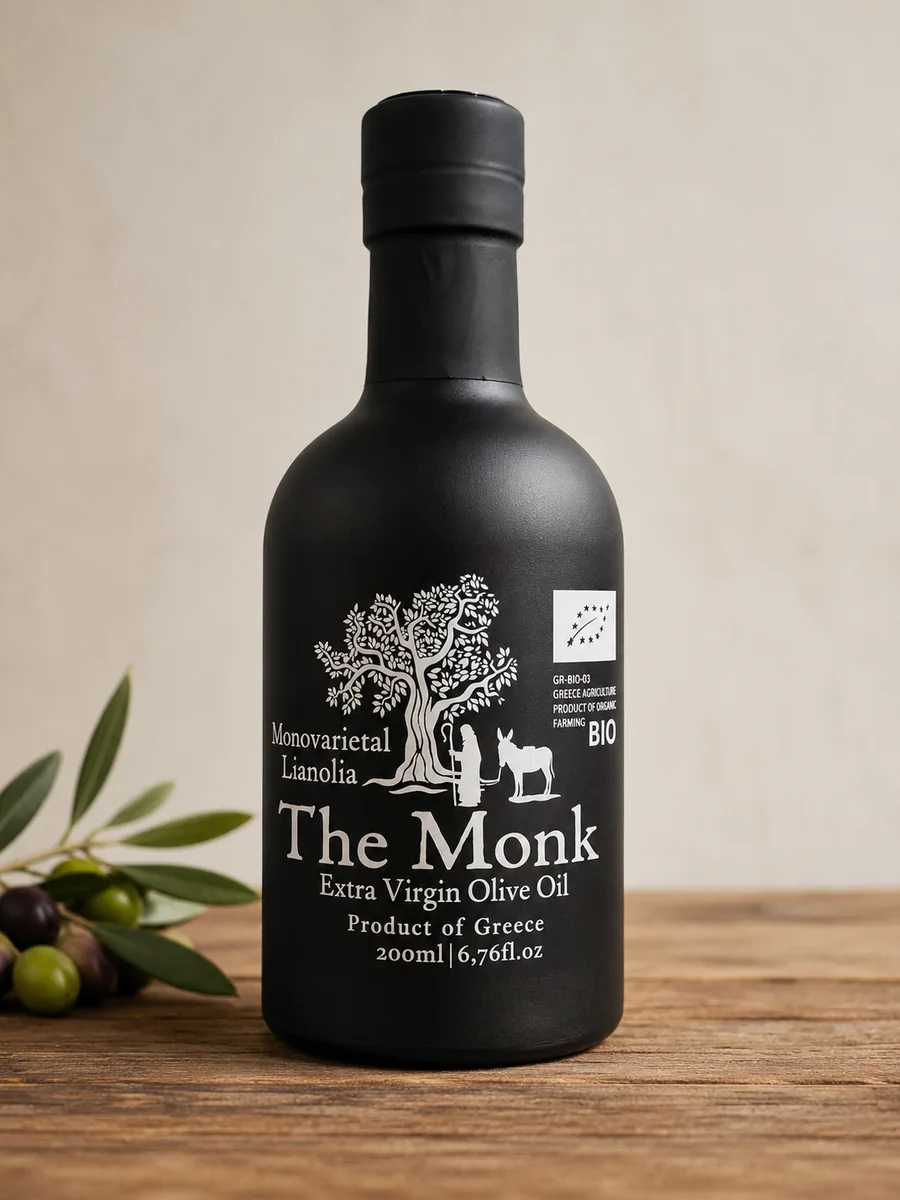
Small-batch organic extra virgin olive oil
01 • Begin with a tasting
Meet the character of your bottle.
Before pairing it with food, take a moment to taste the olive oil on
its own. This simple ritual allows its aromas, bitterness and peppery
finish to reveal themselves gradually.
Pour
Pour a small amount of olive oil into a clean glass. One tablespoon
is enough for a complete tasting.
Warm
Hold the glass in your palm and cover the top with your other hand
for approximately 30 seconds.
Smell
Bring the glass close to your nose and breathe in slowly. Notice the
fresh, green and naturally aromatic notes.
Taste
Take a small sip and allow it to move across your mouth. Notice the
bitterness and the peppery sensation that may follow in the throat.
Bitterness and pungency are part of the experience.
A pleasant bitter taste and a peppery finish are natural sensory
characteristics of high-quality extra virgin olive oil. They are not
signs that the olive oil is too strong or defective.
02 • Serve it simply
Let the olive oil finish the dish.
Its character is best appreciated in simple combinations, where a
small amount can add aroma, depth and a distinctive peppery finish.
Bread & sea salt
Pour a small amount over fresh or lightly toasted bread and finish
with a few grains of sea salt.
Tomato, feta & oregano
Add it just before serving to ripe tomatoes, feta cheese and
aromatic oregano.
Fish & seafood
Drizzle it over grilled fish, prawns or octopus after cooking,
together with a little lemon.
Roasted vegetables
Finish roasted courgettes, peppers, aubergines or potatoes with a
light drizzle before serving.
Soups & legumes
Add it at the table to lentils, beans, chickpeas or vegetable soups
to preserve its fresh aroma.
A surprising finish
Try a few drops over vanilla ice cream, plain yoghurt or dark
chocolate for an unexpected contrast.
03 • Raw or cooked?
Use it freely. Appreciate it simply.
Extra virgin olive oil can be used both raw and in cooking. Because
this is a limited, small-batch olive oil, its aromas and distinctive
character are best appreciated raw or added shortly before serving.
“
The final drizzle preserves more of the aroma and allows the olive oil
to become a visible part of the finished dish.
04 • Preserve its freshness
Protect what is inside.
Light, heat and prolonged contact with air can gradually reduce the
freshness and aromatic character of extra virgin olive oil. A few
simple habits will help your bottle remain at its best.
01
Keep it away from light
Store the bottle inside a cupboard or another shaded place, away
from windows and direct sunlight.
02
Keep it away from heat
Do not leave it beside an oven, cooker, radiator or any area that
becomes warm during the day.
03
Close it after every use
Replace the cap immediately after pouring to limit unnecessary
contact between the olive oil and the air.
04
Enjoy it regularly
Once opened, use the bottle regularly rather than saving it
indefinitely for a special occasion.
The ideal place
A cool, dark kitchen cupboard—away from heat—is usually the simplest
and most suitable place for your bottle.
05 • Natural character
Natural variation is part of every harvest.
The Monk Olive Oil is produced in small quantities and allowed to
clarify naturally. Its appearance and sensory character may therefore
vary slightly from one harvest to another.
01
Slight cloudiness may appear
A light haze can occasionally be visible, especially when the
olive oil is young or exposed to cooler temperatures.
02
A small natural sediment is possible
Fine natural particles may gradually settle at the bottom of the
bottle. This is not, by itself, a sign of spoilage or poor quality.
03
Each harvest has its own expression
Aroma, bitterness and pungency can differ naturally according to
the fruit, weather conditions and moment of harvest.
A simple serving tip
Keep the bottle upright and pour gently. There is no need to shake it
before serving.
06 • Your numbered bottle
One bottle. One harvest. One place.
Your bottle belongs to a limited annual release produced from our
family olive groves in Corfu. It is individually numbered because only
a finite quantity is produced from each harvest.
Like an agricultural vintage, each harvest carries the character of
its season.
Weather, the condition of the fruit and the exact moment of harvest
can influence aroma, bitterness and pungency. These natural
differences are not corrected or standardised to make every year
taste identical.
01
Its origin
Corfu, Greece
Produced from olives grown and harvested on the island of Corfu.
02
Its production
Small-batch
Made in limited quantities, with close attention to each stage
of the process.
03
Its identity
Individually numbered
The number on your bottle marks it as part of this specific
limited release.
More than a batch number
It connects your bottle to a particular harvest, a particular place
and a limited moment in time.
07 • Enjoy your bottle
Open it. Taste it. Make it part of the table.
Your bottle was produced to be enjoyed—not simply stored. Use it in
everyday meals, share it with people you value and return to this guide
whenever you wish to explore its character again.
From our family olive groves in Corfu.
The Monk Olive Oil • Marmaro, Corfu, Greece